
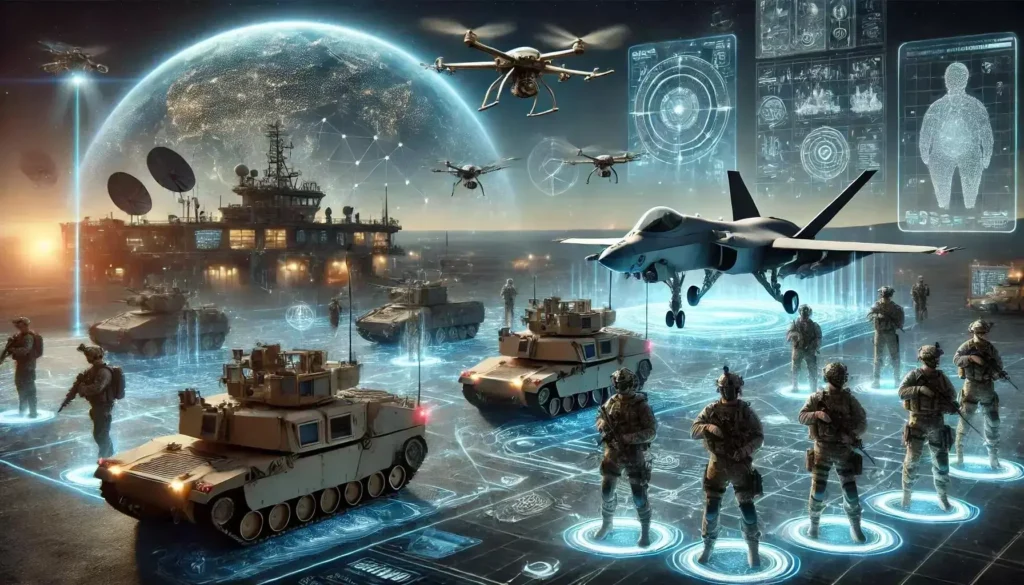
In an era marked by renewed great power competition, strategic military technology has emerged as the primary metric of geopolitical influence. These capabilities are not merely isolated weapons systems. Rather, they represent the foundational digital and kinetic architectures that enable a nation to project power, deter aggression, and secure decision dominance.
Historically, defense posture was measured by counting capital equipment like tanks, fighter jets, and artillery divisions. However, strategic military technology in 2026 is defined by systemic software integration, space resilience, and autonomous decision-making. Consequently, modern deterrence relies on resilient data networks just as much as explosive firepower.
What Defines "Strategic" Military Technology?
Strategic technologies differ fundamentally from tactical hardware in both operational scope and strategic impact. For instance, an improved assault rifle or a small tactical drone can alter a localized skirmish. In contrast, strategic technologies shape entire theater campaigns and nuclear or conventional deterrence postures.
Specifically, modern military planners recognize five defining strategic technology pillars in 2026:
- Space-Based Sensing & SSA: Distributed satellite constellations for continuous early warning tracking and Space Situational Awareness.
- Integrated Air & Missile Defense: Layered sensor networks engineered to intercept hypersonic glide platforms and swarming strikes.
- Agentic AI Command & Control (C2): Autonomous software agents that plan workflows and compress target acquisition times.
- NC3 Modernization: Next-generation nuclear command, control, and communications architectures shielded against high-altitude electromagnetic pulses (HEMP) and zero-day cyber intrusions.
- Long-Range Strike Ecosystems: Hypersonic platforms and standoff precision strike assets connected directly to edge sensor feeds.
Tactical vs. Strategic Capabilities in 2026
When evaluating defense technologies, key operational differences highlight why strategic systems take priority over tactical units:
- Operational Scope: Tactical assets address immediate battlefield engagements, whereas strategic systems maintain theater-wide and global deterrence postures.
- Decision Cycle: Tactical operations function on minutes-to-hours timelines at squad levels, while strategic systems operate in real-time seconds via edge-computed Agentic AI.
- Domain Integration: Tactical tools focus on single domains (such as ground or air combat), whereas strategic platforms rely on mesh-networked multi-domain integration.
- Target Focus: Tactical units focus on field personnel and localized installations, while strategic systems target command hubs, orbital constellations, and subsea cable nodes.
- Core Objective: Tactical tools achieve localized physical control, whereas strategic technologies secure persistent, multi-domain decision dominance.
The Integration Imperative: Building the Multi-Domain Mesh
The single most consequential trend in defense technology is not any standalone warfighting asset. Instead, the primary driver of military technology in 2026 is systemic network integration. Modern warfare dictates that sensors, strike platforms, and commanders function as one dynamic, self-healing network.
For example, the U.S. Department of Defense’s Combined Joint All-Domain Command and Control (CJADC2) concept exemplifies this shift. CJADC2 links sensors and shooters across air, land, sea, space, cyber, and international partners.
This integration relies on three core technical pillars:
- Resilient Edge Connectivity: Utilizing tactical 5G, micro-satellites, and dynamic spectrum management to maintain communication in jammed environments.
- Cloud Battle Management: Running decentralized data networks designed to function even when primary server nodes are destroyed.
- Agentic & Generative AI: Deploying autonomous AI agents to fuse raw telemetry, flag threats, and optimize tactical strike options.
Space as the Ultimate High Ground
No strategic technology analysis can ignore the critical importance of outer space. Proliferated Low-Earth Orbit (LEO) satellite constellations provide the precision navigation (GPS/PNT), early warning missile tracking, and tactical connectivity that underpin modern operations. Consequently, maintaining space domain awareness is directly tied to national security.
However, strategic space assets face growing threats from advanced counterspace platforms:
- Direct-Ascent ASAT Missiles: Kinetic interceptors engineered to destroy low-Earth orbit satellites.
- Co-Orbital Systems: Maneuverable hunter-killer satellites capable of physically disabling or jamming friendly space infrastructure.
- Directed-Energy & Cyber Vectors: Ground-based lasers and malware designed to blind optical sensors or hijack ground station telemetry.
As a result, military space agencies are abandoning heavy, vulnerable satellites. Instead, they are deploying proliferated LEO constellations backed by automated collision avoidance and rapid orbital launch capabilities.
Strategic Deterrence in the 2020s
Nuclear and conventional deterrence postures are experiencing profound technological disruption. Specifically, rapid innovations in aerospace and speed are challenging legacy defense assumptions:
- Hypersonic Glide Vehicles (HGVs): Operating at speeds above Mach 5 with unpredictable maneuverability, HGVs bypass legacy missile defense radars.
- Fractional Orbital Bombardment Systems (FOBS): Weapons platforms that launch into low-Earth orbit to attack from unexpected vectors.
- Dual-Capable Launch Architectures: Delivery systems capable of mounting nuclear or high-explosive conventional warheads create dangerous escalation risks during sudden crises.
Furthermore, subsea infrastructure defense protecting deep-sea communications cables and energy lines—remains a critical pillar of strategic stability.
The Economic Dimension of Strategic Technology
Strategic military technology is inextricably linked to national economic strength, manufacturing scale, and technological supply chains. Market intelligence indicates that global defense expenditure in artificial intelligence continues to accelerate rapidly from under $10 billion in recent years past $11.7 billion in 2026, targeting nearly $20 billion by the decade's end.
Furthermore, three economic pillars dictate future military advantage:
- Semiconductor Fabrication: Access to advanced sub-3nm microchips directly determines the processing capacity of onboard military AI models.
- Rare Earth Processing: Securing refining capacity for critical minerals remains vital for missile guidance components, radar arrays, and electric drive systems.
- Defense Tech Scaling: Nations capable of transitioning software prototypes into mass-manufactured, low-cost attritable platforms will outpace legacy defense acquisition schedules.
Looking Ahead
The strategic technology competition of 2026 will not be won simply by stockpiling heavy conventional weapons. Ultimately, victory belongs to the nations that build the most resilient, AI-connected, and multi-domain defense networks. As space defense, Agentic AI, and hypersonic platforms mature, maintaining technological integration will remain the ultimate foundation of global power.