

Hypersonic weapons are missiles and projectiles that fly at Mach 5 or faster , over 3,800 miles per hour. Unlike ballistic missiles that follow a predictable arc, these weapons maneuver mid-flight, making them nearly impossible to intercept with today’s missile defense systems.
Militaries divide hypersonic weapons into two categories. Hypersonic glide vehicles (HGVs) ride a rocket booster to the edge of space, then detach and surf the atmosphere at speeds up to Mach 20 while steering toward their target. Hypersonic cruise missiles use scramjet engines to sustain hypersonic flight entirely within the atmosphere.
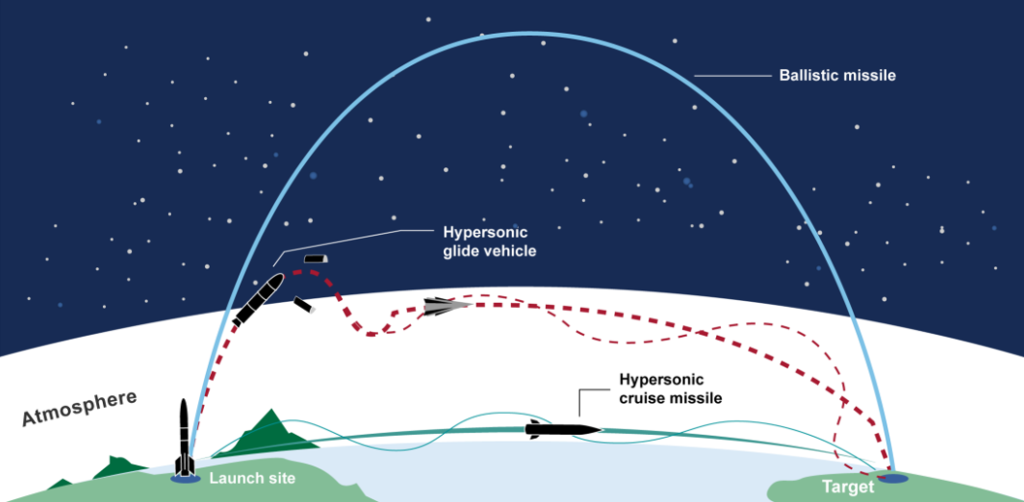
The diagram above shows the critical difference: a ballistic missile arcs through space on a fixed parabola, while a hypersonic glide vehicle weaves through the atmosphere and a hypersonic cruise missile hugs the terrain at Mach 5+.
How Scramjet Engines Power Hypersonic Cruise Missiles
A scramjet, short for supersonic combustion ramjet, is an air-breathing engine with no moving parts. It compresses incoming air through shockwaves, mixes it with fuel, and ignites it while the airflow remains supersonic. At Mach 5, the engine inlet faces temperatures exceeding 3,000°F. Sustaining combustion inside a supersonic hurricane is one of the hardest problems in aerospace engineering.
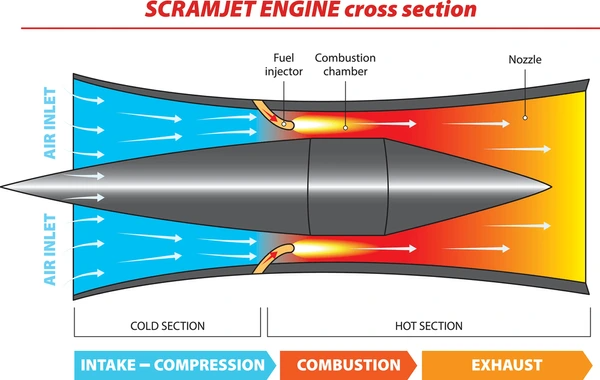
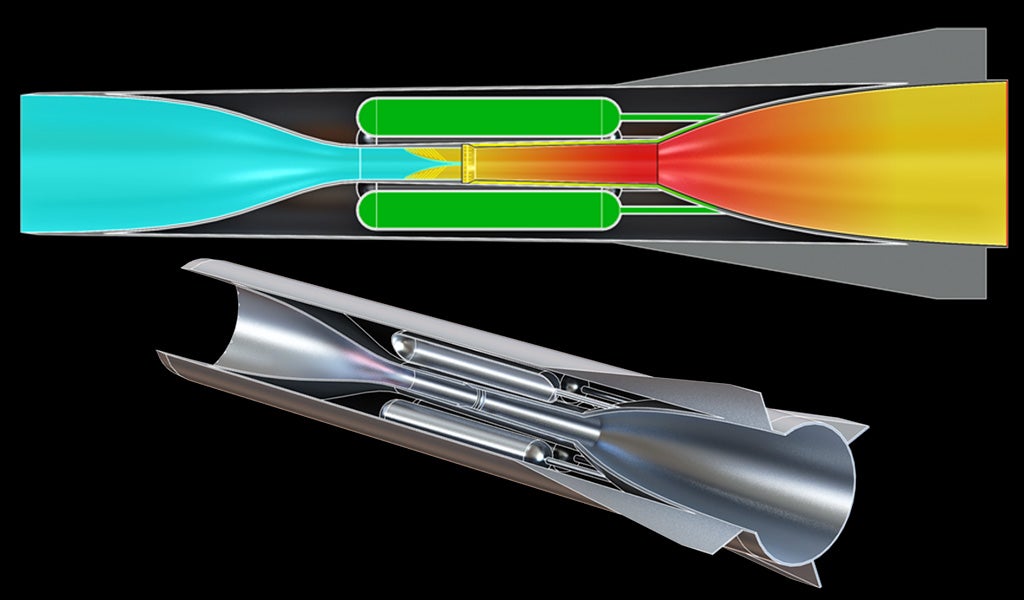
The cross-section diagram shows how air enters the inlet, compresses through the narrowing duct, combusts with injected fuel, and exhausts through the nozzle. The test-fire photo shows the raw power these engines produce during ground testing.
Inside a Hypersonic Glide Vehicle
An HGV is essentially a maneuverable reentry vehicle. After the booster burns out, the glide vehicle separates and uses aerodynamic lift to control its descent. It carries fuel tanks, reaction control systems for steering, and a composite aeroshell to survive plasma-sheath temperatures.
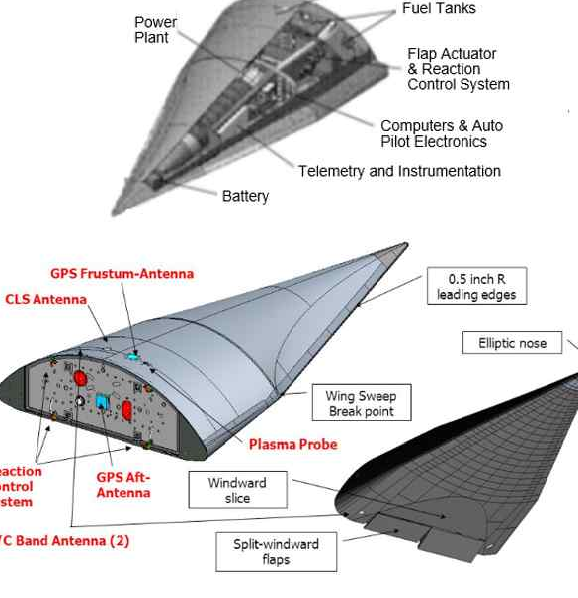
The cutaway reveals the internal architecture: power plant, fuel tanks, flap actuators, GPS antennas, and telemetry systems, all packed inside a shape designed to generate lift while surviving thermal stress that would melt conventional aircraft.
Why Hypersonic Missiles Change Everything
Speed alone is not new. Ballistic reentry vehicles have been hypersonic since the 1960s. The threat is unpredictability. Current missile defense, THAAD, Patriot, Aegis, relies on calculating where an incoming warhead will be and placing an interceptor in its path. When a weapon can bank, dive, and weave at Mach 5+, that math collapses.
The strategic impact is severe. A hypersonic missile fired from Kaliningrad could reach Berlin in under ten minutes. A submarine-launched variant could hit Los Angeles before the Pentagon finishes a phone call. Leaders get no warning time, which pushes nuclear decision-making toward automatic, pre-delegated responses. That makes the world less stable.
Which Countries Have Hypersonic Weapons?
Russia leads in deployment. The Avangard glide vehicle is operational atop ICBMs. The air-launched Kinzhal has been used in Ukraine. The Tsirkon cruise missile is deployed on frigates and submarines.
China paraded the DF-17 in 2019 and is believed to have the world’s most advanced testing infrastructure for scramjet technology. U.S. intelligence assesses that Beijing has operational glide vehicles and is developing air-launched variants.
The DF-17 is mounted on a road-mobile launcher, making it hard to target before launch. Its wedge-shaped glide vehicle is visible atop the booster, the distinctive silhouette that identifies it as an HGV system.
The United States is behind. The Air Force’s AGM-183A ARRW has suffered repeated test failures. The Navy’s Conventional Prompt Strike and the Army’s ground-launched version are delayed. The HACM scramjet cruise missile, developed with Australia, is the most promising program but will not deploy until around 2027. Washington is now pivoting to hypersonic missile defense, funding space-based infrared sensors and directed-energy weapons to detect and intercept these threats.
India successfully tested the HSTDV scramjet demonstrator in 2020 and is co-developing the BrahMos-II with Russia, targeting Mach 7. Japan, France, and Australia all have active glide-vehicle or scramjet programs. Even North Korea claims to have tested the Hwasong-8, though independent verification is limited.
Are Hypersonic Weapons Legal?
No treaty specifically limits hypersonic weapons. New START covers some delivery vehicles, but conventional hypersonic strikes occupy a dangerous gray zone. A conventional hypersonic weapon hitting a nuclear command center looks identical to a nuclear first strike on radar. That ambiguity increases escalation risk.
Frequently Asked Questions
What speed is hypersonic? Hypersonic speed begins at Mach 5, approximately 3,836 miles per hour (6,174 km/h) at sea level.
Can hypersonic weapons be stopped? Currently, no missile defense system has demonstrated a reliable intercept against a maneuvering hypersonic weapon. The U.S. is developing space-based sensors and directed-energy defenses, but these are years from deployment.
Which country has the best hypersonic missile? Russia has the most operational systems (Avangard, Kinzhal, Tsirkon). China has the most advanced testing infrastructure. The U.S. is prioritizing reliability over speed of deployment.
What is the difference between a hypersonic glide vehicle and a cruise missile? A glide vehicle rides a rocket to the edge of space, then glides and maneuvers through the atmosphere. A hypersonic cruise missile uses a scramjet engine to sustain powered flight within the atmosphere.
Read More on Hypersonic Weapons
For submission