

Directed Energy Weapons: Are Lasers Changing Air Defence?
The economics of air defence are under pressure. Militaries increasingly face inexpensive drones that can be launched in numbers, forcing defenders to use costly missiles or expendable ammunition. Directed energy…
At a glance
- The economics of air defence are under pressure. Militaries increasingly face inexpensive drones that can be launched in numbers, forcing defenders to use costly missiles or expendable ammunition. Directed energy…
- In 2026, the United States moved beyond technology demonstrations towards procurement and operational evaluation. Israel delivered its first Iron Beam laser system to the Israel Defense Forces in December 2025, while…
The economics of air defence are under pressure. Militaries increasingly face inexpensive drones that can be launched in numbers, forcing defenders to use costly missiles or expendable ammunition. Directed energy weapons (DEWs), particularly high-energy lasers (HELs) and high-power microwave (HPM) systems, offer a different approach. They use concentrated energy rather than conventional projectiles to damage, disrupt or disable a target. Their attraction is straightforward: potentially low marginal engagement costs, rapid effects and a magazine that can be replenished through a power supply rather than a shipment of missiles.
In 2026, the United States moved beyond technology demonstrations towards procurement and operational evaluation. Israel delivered its first Iron Beam laser system to the Israel Defense Forces in December 2025, while the United Kingdom is preparing to introduce DragonFire on Royal Navy ships from 2027. These developments suggest that directed energy is becoming a practical component of layered air defence. They do not, however, mean that lasers can replace conventional air-defence systems or defeat every aerial threat.
Two technologies, different effects
High-energy lasers concentrate optical energy on a small area of a target. By maintaining the beam on a vulnerable point, a laser can heat and damage structures, sensors, control surfaces or electronics. It can engage a target at the speed of light, but it usually needs a stable track and sufficient dwell time to produce the required effect. Its performance depends on the target’s materials, range, beam quality and atmospheric conditions.
High-power microwave systems work differently. They emit intense electromagnetic energy that can disrupt or damage the electronic components of a target. Depending on the system and target, an HPM pulse may affect several drones within an area rather than requiring a laser to dwell on each aircraft individually. This makes HPM attractive against groups of small uncrewed systems. However, its effects depend on the target’s electronic resilience, the geometry of the engagement and the ability to control electromagnetic effects around friendly equipment and civilian infrastructure.
The distinction is operationally important. A laser is a precision, line-of-sight effector suited to engaging individual targets. An HPM system may offer a wider-area response against multiple electronically vulnerable targets. Neither is a universal solution. A layered defence can combine both with electronic warfare, guns, missiles and other interceptors.
From demonstration to procurement in the United States
A major milestone came on 2 September 2026, when the US Army announced its first production contract for a high-energy laser weapon under the Enduring-High Energy Laser (E-HEL) programme. The Army selected AeroVironment’s LOCUST system, with the contract valued at approximately $464.8 million. The programme aims to provide a mobile counter-unmanned aircraft system (C-UAS) capability and move laser technology from prototypes towards production. The Army describes E-HEL as a system with a low cost per shot and a magazine that regenerates through its power supply. The award is a production step, not proof that a large fleet is already operational.
The US Army also reported a limited real-world use of directed energy. On 31 August 2026, it said personnel at Joint Task Force Southern Border had used an Army Multipurpose High Energy Laser system to defeat three drones assessed as threats near the US-Mexico border. The Army described this as the first use of the system against cartel-linked drones in that mission. This is a significant operational data point, although it should not be confused with broad combat validation against sophisticated military drones, missiles or coordinated saturation attacks.
On 6 October 2026, the US Department of War announced four systems selected for a Joint Interagency Task Force 401 directed-energy counter-drone pilot: AeroVironment’s Palletized High-Energy Laser, Epirus’ Leonidas HPM, Kord’s Firefly laser and Boeing’s Compact Laser Weapon System. The year-long pilot is intended to gather information on performance, cost, sustainment and integration at military installations. The task force has stressed that the systems will complement other counter-drone capabilities rather than act as a single answer to the threat.
Reporting on 19 November indicated that the Pentagon had selected seven additional laser systems for a December live-fire evaluation at Dugway Proving Ground in Utah. The planned event is intended to compare systems against uncrewed aerial targets and assess their potential for procurement. The evaluation itself is not a fielding decision. Its significance lies in the effort to identify technologies that can move more quickly from testing into production.
Israel and the United Kingdom: different paths to deployment
Israel’s Iron Beam illustrates the ambition to integrate high-energy lasers into a national air-defence architecture. On 28 December 2025, the Israeli Ministry of Defense announced delivery of the first system to the IDF. It said the system had completed extensive trials and would complement Iron Dome, David’s Sling and Arrow. The Ministry reported successful test interceptions of rockets, mortars and unmanned aircraft. The system is designed to add a lower-cost engagement option against selected short-range aerial threats.
However, delivery should not automatically be equated with routine operational availability. An August 2026 report by Calcalist’s CTech said Iron Beam had not yet entered operational service, citing the integration and readiness work still required after the handover. The contrast between the official delivery announcement and subsequent reporting demonstrates why assessments of new weapons should distinguish testing, delivery, initial integration and full operational capability.
The United Kingdom is pursuing a naval route. In November 2025, the UK Ministry of Defence announced a £316 million contract for DragonFire systems, with delivery to the Royal Navy from 2027. The Ministry reported that trials had demonstrated engagements against high-speed drones, including above-the-horizon tracking, targeting and interception. The programme aims to provide ships with another defensive layer against aerial threats. Its future effectiveness will depend on integration with ship sensors, combat management systems, power generation and the wider fleet air-defence network.
The limits behind the low-cost promise
Directed energy is often presented as a way to defeat cheap drones at a fraction of the cost of a missile. The marginal cost of electricity for an individual laser engagement may indeed be low. But the full cost includes research and development, procurement, generators, cooling, maintenance, trained operators, sensors, software and infrastructure. A system that fires cheaply but requires expensive support or is unavailable in poor weather may not deliver the expected cost advantage.
Lasers also face physical constraints. They require line of sight, and their beams can be degraded by rain, fog, smoke, dust, salt spray, humidity and atmospheric turbulence. A target may need to remain within the beam for enough time to sustain damage. The power and cooling equipment can make high-energy systems large and difficult to deploy on smaller platforms. High-power microwave systems face different constraints, including the need to understand electromagnetic effects on nearby friendly equipment and the possibility that adversaries will harden their electronics.
The US Government Accountability Office has highlighted atmospheric effects, range, size, weight, power and cooling as important challenges for directed-energy systems. These limitations explain why conventional interceptors remain necessary. Missiles and guns can engage targets beyond line of sight, in adverse weather and across a broader range of threat profiles. Directed energy is most useful when it adds an efficient engagement option to a layered architecture.
Operational requirements for fielding
For any military considering directed-energy systems, the first task is to define the threat set and the locations where the technology could provide a useful additional layer. Fixed installations, forward operating bases and selected naval platforms may offer different opportunities and constraints. Local weather, dust, humidity, line of sight, electrical generation, cooling capacity and maintenance access should shape the assessment from the outset.
Procurement decisions should compare the full lifecycle cost of lasers and HPM systems with guns, electronic warfare and missile interceptors. Trials should measure not only successful engagements but also track continuity, time-on-target, performance in poor weather, effects on friendly electronics, reload or power-cycle rates, crew workload and maintenance burden. A system should enter service only when it demonstrates reliable integration with existing sensors, command networks and layered air-defence procedures.
A new layer, not a silver bullet
Directed energy is entering a more consequential phase. US production contracts and operational trials, Israel’s Iron Beam delivery and Britain’s DragonFire programme demonstrate that high-energy lasers are moving closer to routine military use. High-power microwave systems are also receiving attention as a possible answer to drone formations. Yet their actual value will depend on reliability, weather tolerance, power, sustainment, integration and the ability to defeat evolving threats.
The strategic shift is therefore not the replacement of missiles by lasers. It is the emergence of a more diverse air-defence architecture in which guns, electronic warfare, missiles, lasers and microwave systems each address different parts of the threat spectrum. Militaries that understand these trade-offs—and test systems under realistic conditions—will be better placed to manage the growing cost and complexity of countering unmanned aerial threats.
References
- US Army, “Army awards production contract for Enduring-High Energy Laser System,” 2 September 2026.
- US Army, “Army lasers blast drones, proving directed-energy weapons are future,” 31 August 2026.
- US Department of War, “Systems Selected for JIATF 401 Directed-Energy Counter-Drone Pilot Program,” 5 October 2026.
- Business Insider, “The Pentagon wants to buy laser weapons to take down drones. First, it’s holding a shoot-off,” 19 November 2026.
- Israel Ministry of Defense, “Israel MOD and Rafael Deliver First Operational High-Power Laser System – Iron Beam to the IDF,” 28 December 2025.
- CTech, “Israel’s Iron Beam laser was hailed as a breakthrough. It still isn’t operational,” 10 August 2026.
- UK Ministry of Defence, “Boost for Armed Forces as new laser weapon takes down high-speed drones,” 20 November 2025.
- US Government Accountability Office, “Directed Energy Weapons: DOD Should Focus on Transition Planning,” GAO-23-105868.
- Congressional Research Service, “Department of Defense Directed Energy Weapons: Background and Issues for Congress,” 11 July 2024.
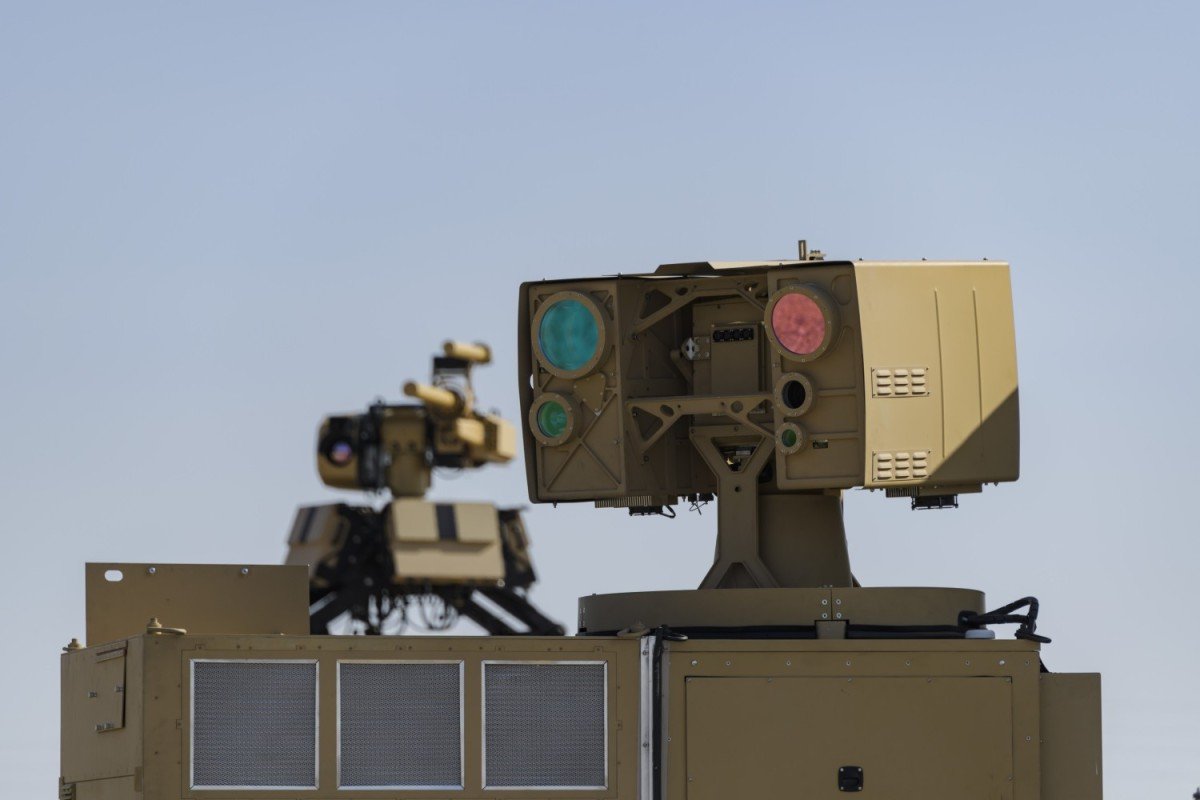
Image: US Army Palletized High Energy Laser system at Yuma Proving Ground. Source: US Army.
One Response