
For more than a century, military land power rested on a simple, unquestioned premise: if you want to control territory, you need heavy steel. The Main Battle Tank, a multi-million-dollar behemoth of composite armor, massive diesel horsepower, and heavy firepower, was the undeniable king of the battlefield. Entire strategic doctrines, industrial supply chains, and military budgets were built around protecting four soldiers inside a rolling fortress.
That era is over. The king is not just vulnerable; it is economically broken.
Walk onto any modern high-intensity battlefield today, and the stark asymmetry of contemporary land warfare becomes undeniable. Multi-layered kill webs—fed by overhead satellite imagery, thermal reconnaissance, and swarms of $500 First-Person View (FPV) kamikaze drones—have turned contested ground into a transparent killing floor. When a cheap, commercially manufactured drone or a shoulder-fired anti-tank missile can reliably neutralize a $15 million tank and permanently wipe out its irreplaceable, highly trained crew, the traditional balance of force projection collapses.
Militaries are suffering an existential cost-exchange crisis. You simply cannot win a war of attrition when your offensive units cost tens of millions to manufacture and take years to replace, while the weapons destroying them are built in garage workshops for the price of a laptop.
Enter the Unmanned Ground Vehicle (UGV).
The rapid field deployment of autonomous ground robotics and Robotic Combat Vehicles (RCVs) represents far more than an incremental technology upgrade. It is a fundamental shift in how nations construct land power. Recent operational data underscores this acceleration: the Ukrainian Defence Ministry contracted over 25,000 Unmanned Ground Vehicles in 2026 alone to take over frontline logistics, assault support, and mine-clearing roles.
By removing human bodies from the front-line chassis, UGVs shatter the central economic constraint of traditional armor: the requirement for extreme, ultra-expensive survival plating designed around human physiology. As frontline commands transition up to 100% of high-risk resupply and medical evacuation to ground robots, the operational model shifts permanently toward machine-first warfare.
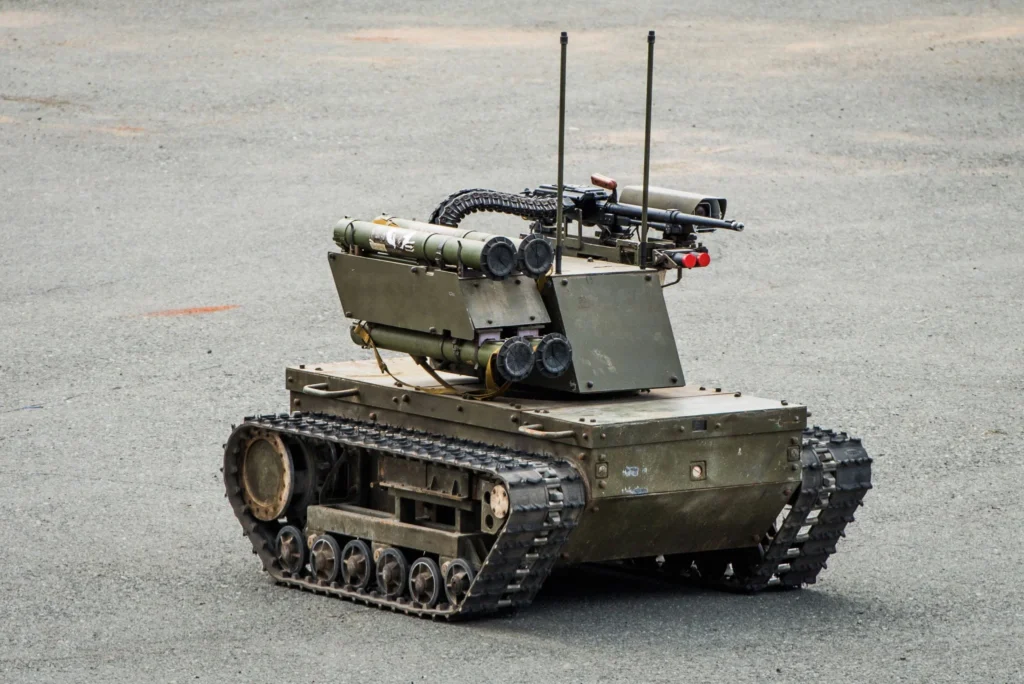
Without the need to protect a living crew from catastrophic kinetic pressure, ground platform designs undergo a radical collapse in size, weight, and procurement cost. Proven modular platforms like the Milrem Robotics THeMIS UGV demonstrate that a combat-capable, track-driven robot armed with a remote autocannon or anti-tank missiles does not cost $15 million. It costs a fraction of that figure. More importantly, it is attritable. If a ground robot absorbs a loitering munition while clearing an obstacle, it represents an acceptable material loss, not a national tragedy or an irreplaceable loss of human capital.
Critics frequently argue that ground domain robotics face physical barriers that air-based drones do not. Terrain is brutal; mud, urban rubble, thick tree lines, and steep inclines present constant physical friction. Furthermore, electronic warfare (EW) environments on the front lines are so saturated with jamming signals that remotely driving a robot with a joystick via satellite or radio link is often impossible.
These objections, however, miss the shift taking place inside modern vehicle design: edge computing and localized artificial intelligence. The U.S. Army is directly countering these friction points by pushing forward with its cheaper Robotic Combat Vehicle competition and aggressively testing off-road autonomy software packages. Modern military UGVs do not rely on a continuous, distant human driver. Armed with stereoscopic cameras, LIDAR mapping, and local AI autonomy engines, these platforms navigate complex, obstructed environments entirely offline—making them resilient against heavy electronic jamming.
The geopolitical consequences of this technological transition are immense. Armies across major military powers face staggering recruiting deficits and shrinking demographics. In high-intensity flashpoints—from urban defense corridors to rugged border zones—the ability to field massed, automated ground networks solves the critical problem of manpower exhaustion. Furthermore, while building a conventional tank requires specialized, slow-moving heavy foundries, medium-scale UGVs can be manufactured utilizing commercial automotive assembly lines and off-the-shelf electronic architectures.
This is not to suggest that human soldiers are obsolete. Rather, the role of the soldier is evolving from front-line kinetic shield to battlefield mission manager. In modern combined-arms doctrine, human operators remain safely back in command vehicles or concealed positions, orchestrating teams of forward-deployed UGVs acting as advance scouts, missile platforms, and mobile electronic warfare shields.
The transition to robotic land warfare will be uncomfortable for defense establishments steeped in century-old armored traditions. But strategic reality does not care about institutional nostalgia. Victory in future land conflicts will not belong to the side that fields the most expensive armor; it will belong to the side that masters the mass production, algorithmic execution, and tactical deployment of autonomous ground power.
Frequently Asked Questions
What is an Unmanned Ground Vehicle (UGV)?
An Unmanned Ground Vehicle (UGV) is a motorized land platform that operates without a human crew on board, utilizing remote tele-operation or onboard artificial intelligence to navigate.
How do UGVs solve the “cost-exchange” problem of modern tanks?
Main Battle Tanks cost $10M–$15M and require years to manufacture, making them vulnerable to cheap drones and anti-tank weapons. UGVs are much cheaper to produce, carry no human risk, and can be replaced quickly in high-attrition environments.
Can military UGVs operate when radio and GPS signals are jammed?
Yes. Modern UGVs use edge computing, LIDAR, stereoscopic cameras, and onboard AI to navigate complex terrain autonomously without needing constant GPS or remote control links.
Are military UGVs allowed to fire weapons autonomously?
Current military operational doctrines mandate a “human-in-the-loop” requirement for lethal engagements. The UGV handles navigation and threat tracking autonomously, but a human operator authorizes weapon discharge.
Read More o