

Autonomous Weapons Regulation: Geneva’s 2026 Deal Leaves Treaty Question Open
The international effort to regulate lethal autonomous weapon systems (LAWS) has reached a turning point, but not the breakthrough many governments and humanitarian organisations wanted. On 20 November 2026, the…
At a glance
- The international effort to regulate lethal autonomous weapon systems (LAWS) has reached a turning point, but not the breakthrough many governments and humanitarian organisations wanted. On 20 November 2026, the…
- The outcome matters because it moves the debate beyond another open-ended discussion, while preserving the disagreement at its centre: should states adopt binding prohibitions and restrictions, or rely on non-binding…
The international effort to regulate lethal autonomous weapon systems (LAWS) has reached a turning point, but not the breakthrough many governments and humanitarian organisations wanted. On 20 November 2026, the Seventh Review Conference of the Convention on Certain Conventional Weapons (CCW) in Geneva agreed to continue work on an international instrument covering autonomous weapons. The process will run through 2027 and 2028. However, states did not agree to begin negotiations on a legally binding protocol immediately. Instead, they left the instrument’s legal form open until the process produces recommendations in 2028.
The outcome matters because it moves the debate beyond another open-ended discussion, while preserving the disagreement at its centre: should states adopt binding prohibitions and restrictions, or rely on non-binding guidance and existing international humanitarian law (IHL)? The Geneva decision creates a negotiating pathway. It does not yet establish the rules that will govern autonomous weapons.
What did the Geneva conference actually agree?
The CCW brings together 128 High Contracting Parties and provides a framework for prohibiting or restricting weapons considered excessively injurious or indiscriminate. Its existing protocols address weapons such as blinding laser weapons, incendiary weapons, mines and explosive remnants of war. The Seventh Review Conference, held from 16 to 20 November 2026, considered the future of the Group of Governmental Experts on LAWS after the group adopted a consensus report in September.
According to the compromise described by the Association for the Promotion of International Law and Security (APILS), the Group will elaborate, by consensus, an instrument specifying the IHL principles and requirements applicable to lethal autonomous weapon systems, their implementation and other possible measures. It will build on the elements agreed by the GGE in 2026. The Group must report to the 2028 Meeting of High Contracting Parties and recommend the instrument’s legal nature and form, including whether states should adopt it as a binding protocol.
Switzerland, which chaired the Review Conference, called the agreement a significant step after more than a decade of discussions. It also acknowledged that consensus did not allow states to agree immediately on a mandate for a legally binding instrument. The final legal form remains undecided. This is the essential distinction: states agreed to develop an instrument, not to negotiate a treaty with a predetermined legal status.
Why the compromise falls short of a treaty
The CCW operates through consensus. Every High Contracting Party can prevent agreement on a decision, even when a substantial majority supports a particular approach. This structure can preserve the participation of major military powers, but it can also slow progress when states disagree over the limits that new weapons should face.
Before the conference, a group of states including Austria, Belgium, Brazil, Ireland, Mexico, New Zealand and Panama pressed for a legally binding protocol. Their working paper called for clear prohibitions on certain autonomous weapons and restrictions on others. It argued that a future instrument should preserve human judgement and control, address algorithmic bias, and require safeguards throughout the weapons lifecycle, including legal reviews, testing and risk mitigation.
The International Committee of the Red Cross (ICRC) had also urged states to launch negotiations on a new protocol. After the conference, it regretted that states had not agreed to an immediate mandate for a legally binding instrument. The ICRC argues that future rules should prohibit systems that pose unacceptable risks under IHL, including unpredictable autonomous weapons and those designed to target humans directly, while restricting the development and use of other systems.
Other states favour a more cautious approach. The debate concerns more than legal wording. It reflects different views about military utility, operational flexibility, the adequacy of existing IHL and the risks of constraining national defence programmes. The final compromise preserves the possibility of a binding protocol, but it also gives states two more years to negotiate its form.
The real regulatory problem: defining meaningful human control
Autonomous weapons do not all operate in the same way. Some systems automate navigation, tracking or defensive interception while humans define the mission and authorise engagement. Others may identify, select and engage targets after activation with little or no further human intervention. A credible regulatory framework must distinguish between these functions rather than treat every use of automation as equivalent.
The central issue is the relationship between human judgement and the use of force. A human operator cannot exercise meaningful control simply by approving a system once and then losing the ability to understand or influence its actions. Effective control requires sufficient information about the system, an understanding of the operational context, limits on its targets and area of operation, and the ability to intervene where feasible. It also requires commanders and states to retain responsibility for decisions made through autonomous systems.
Existing IHL already applies to the use of weapons, regardless of their technological sophistication. The principles of distinction, proportionality and precautions in attack remain relevant. Yet autonomous systems raise difficult questions about how armed forces can reliably assess civilian presence, changing circumstances and the expected effects of an attack when software performs critical targeting functions. A new instrument should translate these legal principles into operational requirements that states can test and enforce.
Why the next two years matter
The 2027–2028 process should not become another cycle of general statements. States have already spent more than a decade examining the legal, military, technical and ethical implications of LAWS. The September 2026 GGE report provides a starting point, and the next phase should focus on drafting concrete provisions.
At minimum, negotiators should address three areas. First, they should define prohibited systems through their effects and functions, including systems whose behaviour cannot be sufficiently understood, predicted or constrained to comply with IHL. Second, they should establish restrictions for other systems, such as limits on target types, duration, geographic scope and the number of engagements. Third, they should require lifecycle safeguards: testing, validation, legal reviews, human supervision, auditability and clear lines of command responsibility.
States should also avoid a false choice between innovation and regulation. Rules do not need to prohibit every autonomous function. They should establish boundaries for the use of force while allowing systems that can operate within clear legal and operational constraints. This approach can improve predictability for armed forces and reduce risks to civilians.
Implementation beyond Geneva
The diplomatic process will only matter if states translate principles into national practice. Governments should review weapons-acquisition procedures, strengthen legal reviews under Article 36 of Additional Protocol I where applicable, and ensure that commanders understand the limits of systems used in their operations. Testing should examine performance in realistic environments, including degraded communications, civilian presence, sensor uncertainty and adversarial interference.
International discussions should also address transparency and accountability. States can exchange information on testing methods, human-supervision arrangements and incident-investigation procedures without disclosing sensitive operational details. These steps would help build confidence while negotiators work towards an instrument with clear prohibitions, restrictions and implementation requirements.
From process to enforceable rules
The Geneva agreement is neither a treaty nor a failure. It establishes a time-bound process and keeps the possibility of binding rules alive. But the compromise also exposes the limits of consensus diplomacy when states disagree over the regulation of emerging military technologies. The test will be whether governments use the next two years to draft clear, practical and verifiable provisions—or allow the legal status question to delay substantive progress again.
Autonomous weapons raise questions that cannot be answered by technical performance alone. Military effectiveness does not determine whether a system can distinguish lawful targets, respond to changing conditions or preserve human responsibility for lethal decisions. The international community now has a framework and a deadline. It should use both to ensure that the development of military autonomy does not outpace the rules intended to govern its use.
References
- Swiss Federal Department of Foreign Affairs, “New mandate on lethal autonomous weapons systems adopted in Geneva,” 21 November 2026.
- Association for the Promotion of International Law and Security, “CCW Seventh Review Conference: A New Mandate on Autonomous Weapons, But No Review,” 21 November 2026.
- International Committee of the Red Cross, “ICRC renews urgent call for legally binding rules on autonomous weapons after failure to launch negotiations,” 21 November 2026.
- United Nations Office at Geneva, “Seventh Review Conference of the High Contracting Parties to the Convention on Certain Conventional Weapons,” 10 November 2026.
- United Nations, “Autonomous Weapon Systems: Frequently Asked Questions.”
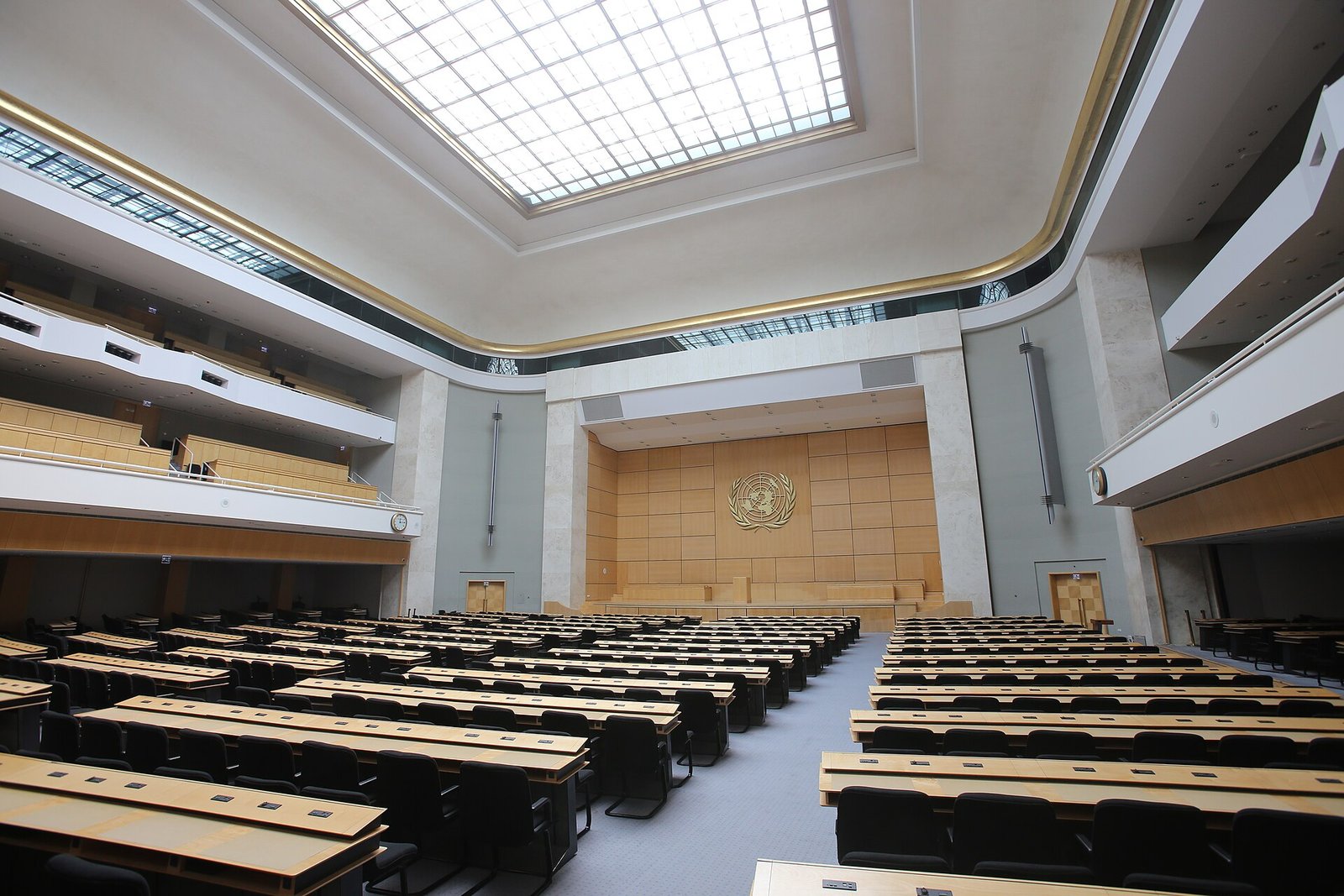
Featured image: United Nations Geneva Assembly Hall, photograph by Ludovic Courtès, CC BY-SA 3.0, via Wikimedia Commons.
One Response